Analysis Opinion Research
Science Agrees: You Cannot Cease to Exist. Here's What That Means for the Soul
Analysis · 10 May 2026 · 9 min read
All Articles
D
dev@snm.co.za
Analysis · May 2026
Of all the fears that human beings carry through their lives, the fear of death is perhaps the most universal. The prospect of simply ceasing to exist - of the light going out permanently, of the self that has thought and loved and wondered since childhood arriving at a final, absolute end - drives more anxiety, more desperate grasping at comfort, and more vulnerability to manipulation than almost any other human experience.
Institutions have always known this. The promise of heaven and the threat of hell have been among the most powerful tools of human control for millennia. And the fear beneath those promises - the terror of nonexistence - is what makes people susceptible to accepting those promises on whatever terms an institution decides to offer.
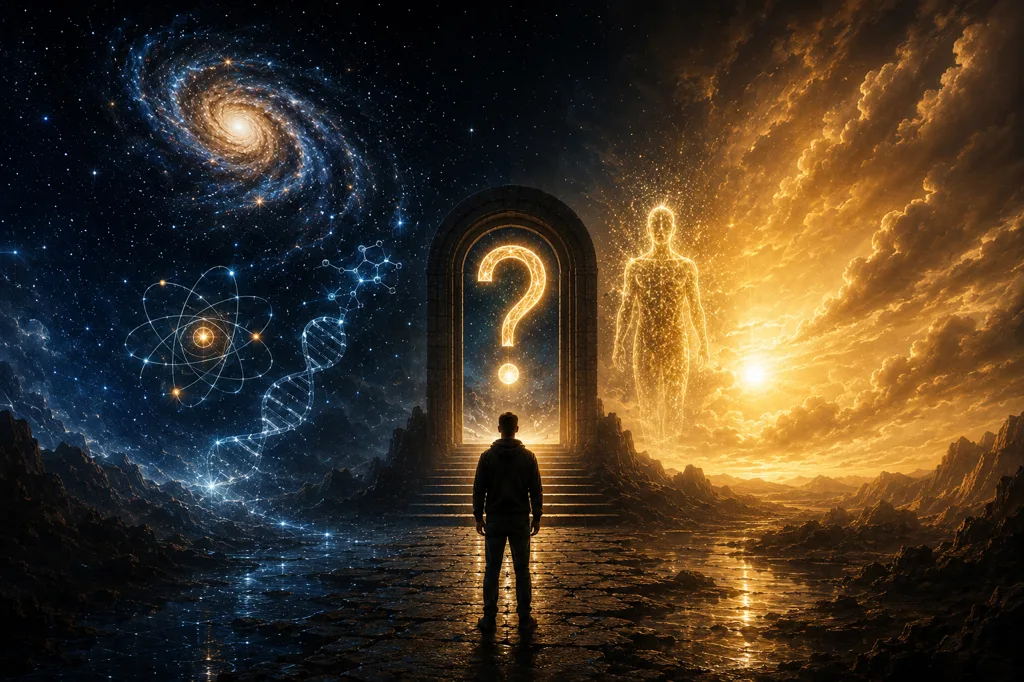
But what if the fear is based on a misunderstanding - not just a spiritual misunderstanding, but a scientific one? What if the most fundamental laws of physics, the same laws that govern the universe from the smallest subatomic particle to the largest galaxy, make it not merely spiritually reasonable but physically impossible for you to simply cease to exist?
The Law That Changes Everything
In 1905, Albert Einstein published his special theory of relativity, which established one of the most profound insights in the history of science: mass and energy are not separate phenomena. They are different forms of the same thing. The famous equation E=mc² expresses the relationship between them - and its implications extend far beyond nuclear physics.
The Law of Conservation of Energy
The total amount of energy in a closed system - including the universe as a whole - is constant. Energy cannot be created from nothing, and it cannot be destroyed into nothing. It can only change form. This is one of the most rigorously tested and universally accepted laws in all of science.
The Law of Conservation of Matter
The total amount of matter in the universe always has been and always will be the same. Matter, like energy, does not cease to exist - it transforms. The atoms that make up your body today have existed since the formation of stars. They will continue to exist long after the body has decomposed.
 Together, these two laws - among the most rigorously tested in all of science - establish something remarkable: it is physically impossible for you to simply cease to exist.
Together, these two laws - among the most rigorously tested in all of science - establish something remarkable: it is physically impossible for you to simply cease to exist.
When a body dies and decomposes, the matter and energy that constituted it do not disappear. The carbon atoms that formed your cells are released into the soil, the air, the water - absorbed by plants, by organisms, by the cycles of life that have been running for billions of years. Your physical substance continues, transformed but not destroyed. The energy that animated your living body is conserved in the system, changed in form but not extinguished.
"The universe has a strict rule: nothing ceases to exist. Everything transforms. Your body is no exception. But what about the rest of you?"
What Science Cannot - Yet - Observe
Here is where the conversation becomes more interesting. The laws of conservation apply to measurable physical matter and energy. They say nothing definitive about consciousness, about the experience of being aware, about the quality of inner life that each person knows intimately and that science has not yet succeeded in fully explaining.
But science's inability to directly observe something is not the same as proof that it does not exist. This is a point that physics itself makes with considerable force.
Consider the subatomic world. No one has ever directly observed an atom. No one has ever seen an electron. Not even with the most powerful microscopes available - because atoms are too small to interact with visible light and therefore cannot form an image on a retina. And yet the existence of atoms and subatomic particles is not seriously disputed. We know they exist through inference, through the patterns of evidence they leave, through their effects - not through direct sensory observation.
The same logic applies to phenomena like thought, emotion and intuition. These cannot be seen, touched, smelled, heard or tasted. They cannot be placed on a scale or measured with a ruler. Yet no one sincerely argues that their thoughts do not exist because they cannot be directly observed with the five senses.
Consciousness - the experience of being aware, of having an inner life - remains one of the deepest unsolved problems in science precisely because it does not fit neatly into the categories of measurable physical phenomena. It is, in the language of philosophy, the "hard problem": not the mechanics of the brain, which neuroscience is steadily mapping, but the question of why there is subjective experience at all. Why is there something it is like to be you, rather than nothing?
The Brain, the Soul, and the Right Side of the Question
Neurological research has revealed something fascinating about the difference between the two hemispheres of the brain. The left hemisphere tends to organise and categorise sensory input - to make logical sense of the world. The right hemisphere tends to receive sensory experience more openly, without immediately demanding rational categorisation.
This is why a person can stand under a clear night sky and look up at the stars and be moved by something that they cannot fully articulate — a sense of vastness, of connection, of wonder that exceeds what logical analysis alone can produce. The right hemisphere is receiving something that the left hemisphere cannot fully process.
Intuition operates in a similar space. The ability to understand something - to know it - without the process of conscious reasoning is not recognised by mainstream psychology as a distinct faculty, but its effects are widely experienced. Many people have had the experience of knowing something before they could explain how they knew it. Of sensing danger or opportunity without clear logical grounds. Of receiving what can only be described as guidance from a source that does not originate in deliberate rational thought.
These experiences do not prove the existence of a soul in the theological sense. But they do suggest that human consciousness is not exhausted by what the five senses can directly perceive and what logical analysis can categorise. There is, in the language of physics, more going on than is currently observable.
What Jesus Said About Life After the Body
This is precisely the territory in which the teachings of Jesus become scientifically interesting rather than merely spiritually comforting. Jesus spoke consistently about the rational soul - the inner life of a person - as distinct from the physical body, and as the seat of what continues after physical death.
"It is the spirit that quickeneth; the flesh profiteth nothing: the words that I speak unto you, they are spirit, and they are life."
John 6:63
The body - the flesh - profits nothing in terms of eternal life. The spirit, the rational soul, is where life actually resides. And the words of God that Jesus came to share are themselves described as spirit and life - not as rules to be obeyed but as living truth to be absorbed and experienced.
"He that heareth my word, and believeth on him that sent me, hath everlasting life, and shall not come into condemnation; but is passed from death unto life."
John 5:24
The transition from death to life that Jesus describes is not merely a future event. It is a present reality - a shift in the orientation of the soul from the temporal to the eternal, from fear of nonexistence to confidence in the continuity of conscious life beyond the death of the physical body.
Jesus used the image of a grain of wheat to describe this transition:
"Verily, verily, I say unto you, Except a corn of wheat fall into the ground and die, it abideth alone: but if it die, it bringeth forth much fruit."
John 12:24
The grain does not cease to exist when it falls into the ground. It transforms - it passes through what looks like death and emerges as something far more abundant. The analogy is precise and, from a scientific perspective, entirely consistent with what we know about the conservation of matter. The grain's substance continues. Its form changes. And what emerges is incomparably richer than what went in.
"The grain of wheat does not cease to exist when it falls into the ground. It transforms. Jesus said we are no different."
Faith as a Scientific Method
There is a way of approaching faith that treats it as the opposite of evidence - as belief in spite of what can be observed. But Jesus described faith differently. He described it as something to be tested, to be experienced, to be validated through practice - not accepted blindly on institutional authority.
When a Pharisee challenged Jesus about the truth of his teaching, Jesus offered an empirical response:
"If any man will do his will, he shall know of the doctrine, whether it be of God, or whether I speak of myself."
John 7:17
This is an invitation to experiment. Put the teachings into practice. Live by them - not as an exercise in compliance but as a genuine test of whether they produce the results Jesus described. The truth, he says, will be knowable through the experience of practicing it. This is not blind faith. It is applied faith - the kind of knowing that comes not from being told what to believe but from personally verifying what is true.
The same approach applies to the question of consciousness after death. It cannot be directly observed with the five senses any more than an atom can be directly seen with the naked eye. But its existence can be approached through inference, through the evidence of the conservation laws, through the testimony of those who have had experiences that point beyond the physical, and through the personal practice of seeking guidance from the Comforter - the Spirit of truth that Jesus promised would lead each person into all truth.
The fear of death is real. The institutions that have exploited that fear are real. But the foundation of that fear - the belief that you will simply cease to exist when your body dies - is contradicted by the most fundamental laws of physics. You cannot cease to exist. The only question is what form your existence takes next. And on that question, both the Gospels and the deepest insights of modern science point in the same direction: not toward annihilation, but toward transformation.
